
Scientific interests
- Milky way
- Figure A: Sabatini et al. 2019, MNRAS 490, 4489, “On the size of the CO-depletion radius in the IRDC G351.77-0.51”, Figure 1. DOI: 10.1093/mnras/stz2818
- Figure B: adapted from Giannetti et al. 2017, A&A 603, A33, “ATLASGAL-selected massive clumps in the inner Galaxy. V. Temperature structure and evolution”, Figure 15, DOI: 10.1051/0004-6361/201630048, and Sabatini 2021, PhD thesis, “Establishing a timeline for the high-mass star formation process”
- Figure C: Reid et al. 2019, ApJ 885, 131, “Trigonometric Parallaxes of High-mass Star-forming Regions: Our View of the Milky Way”, adapted from Figure 2. DOI: 10.3847/1538-4357/ab4a11
- Figure D: courtesy Winnberg, Brand & Engels
- Nearby galaxies
- Multi-wavelength studies of Nearby Galaxies from low to high frequencies
- Magnetic fields and cosmic rays role in star formation
- Environmental effects on gas removal and star formation
- Statistical properties of galaxies
- Bonato M., et al., 2014a, MNRAS, 438, 2547, “Exploring the early dust-obscured phase of galaxy formation with blind mid-/far-infrared spectroscopic surveys” ;
- Bonato M., et al., 2014b, MNRAS, 444, 3446, “Exploring the relationship between black hole accretion and star formation with blind mid-/far-infrared spectroscopic surveys“;
- Bonato M., et al., 2015, MNRAS, 452, 356, “Predictions for surveys with the SPICA Mid-infrared Instrument“;
- Bonato M., et al., 2017a, ApJ, 836, 171, “Exploring the Evolution of Star Formation and Dwarf Galaxy Properties with JWST/MIRI Serendipitous Spectroscopic Surveys“;
- Bonato M., et al., 2017b, MNRAS, 469, 1912, “Does the evolution of the radio luminosity function of star-forming galaxies match that of the star formation rate function?“;
- Bonato M., et al., 2018, MNRAS, 478, 1512, “ALMACAL IV: a catalogue of ALMA calibrator continuum observations“;
- Bonato M., et al., 2019a, PASA, 36, e017, “Origins Space Telescope: Predictions for far-IR spectroscopic surveys“;
- Bonato M., et al., 2019b, MNRAS, 485, 1188, “ALMA photometry of extragalactic radio sources“;
- Bonato M., et al., 2021a, MNRAS, 500, 22, “New constraints on the 1.4 GHz source number counts and luminosity functions in the Lockman Hole field“;
- Bonato M., et al., 2021b, A&A, 656, A48, “The LOFAR Two-metre Sky Survey Deep Fields. A new analysis of low-frequency radio luminosity as a star-formation tracer in the Lockman Hole region“;
- Massardi M., et al., 2008, MNRAS, 384, 775, “Observability of the virialization phase of spheroidal galaxies with radio arrays“;
- Massardi M., et al., 2009, MNRAS, 392, 733, “Blind and non-blind source detection in WMAP 5-yr maps“;
- Massardi M., et al., 2011a, MNRAS, 412, 318, “The Australia Telescope 20 GHz (AT20G) Survey: analysis of the extragalactic source sample“;
- Massardi M., et al., 2011b, MNRAS, 415, 1597, “The Planck-ATCA Co-eval Observations project: the bright sample“;
- Massardi M., et al., 2013, MNRAS, 436, 2915, “A polarization survey of bright extragalactic AT20G sources“;
- AGN jets
- estimate of fundamental jet parameters (e.g. velocity, viewing angle, magnetic field, SED, etc)
- investigation of the correlation between jet power and radio type
- characterization of jet on different angular scales, from parsec to kiloparsec
- study of the possible presence of AGN feedback
- Galaxy evolution
- Bonato M., et al., 2014a, MNRAS, 438, 2547, “Exploring the early dust-obscured phase of galaxy formation with blind mid-/far-infrared spectroscopic surveys” ;
- Bonato M., et al., 2014b, MNRAS, 444, 3446, “Exploring the relationship between black hole accretion and star formation with blind mid-/far-infrared spectroscopic surveys“;
- Bonato M., et al., 2015, MNRAS, 452, 356, “Predictions for surveys with the SPICA Mid-infrared Instrument“;
- Bonato M., et al., 2017a, ApJ, 836, 171, “Exploring the Evolution of Star Formation and Dwarf Galaxy Properties with JWST/MIRI Serendipitous Spectroscopic Surveys“;
- Bonato M., et al., 2017b, MNRAS, 469, 1912, “Does the evolution of the radio luminosity function of star-forming galaxies match that of the star formation rate function?“;
- Bonato M., et al., 2019, PASA, 36, e017, “Origins Space Telescope: Predictions for far-IR spectroscopic surveys“;
- Massardi M. & De Zotti G., 2004, A&A, 424, 409, “Radio source contamination of the Sunyaev-Zeldovich effect in galaxy clusters“;
- Massardi M., et al., 2010a, ApJ, 718, L23, “High Angular Resolution Observation of the Sunyaev-Zel’Dovich Effect in the Massive z ≈ 0.83 Cluster Cl J0152-1357“;
- Massardi M., et al., 2010b, MNRAS, 404, 532, “A model for the cosmological evolution of low-frequency radio sources“;
- Massardi M., et al., 2016, MNRAS, 455, 3249, “The Planck-ATCA Co-eval Observations project: analysis of radio source properties between 5 and 217 GHz“;
- Massardi M., et al., 2018, A&A, 610, A53, “Chandra and ALMA observations of the nuclear activity in two strongly lensed star-forming galaxies“;
Milky way
At It-ARC, a branch of our research concerns our own Galaxy, the Milky Way, and focuses on a range of scientific topics, such as Galactic spiral structure, molecular clouds and star formation across the Galactic disk, the physics and chemistry of the interstellar medium, and stellar and interstellar masers. These lines of research are pursued by making observations with world-class telescopes and instrumentation in spectral regions from the radio to the optical, via millimeter and the infrared.
Contacts: J. Brand (j.brand@ira.inaf.it), K. Rygl (kazi@ira.inaf.it), G. Sabatini (giovanni.sabatini@inaf.it)
Galactic star formation
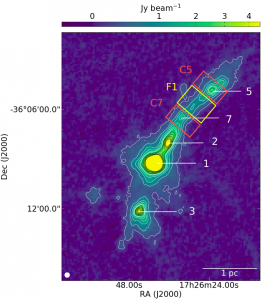
Fig. A: Image of the dust emission in G353.77-0.51, a filamentary star-forming region, observed with the Large APEX Bolometer Camera at 870 micron;
Across the Galaxy there are cold regions (10-20 K) where the interstellar gas, mainly composed of molecular hydrogen, condenses to reach particle densities of 1000-10000 cm-3 and higher: these regions are found to give birth to new generations of stars. Since young stars are born inside cocoons of gas and dust, which provide the mass reservoir for the growing star but absorb the visible light, these early phases in the stellar evolution can be mainly studied through radio and (sub-) millimeter observations. It-ARC researchers make use of the emission coming from increasingly complex molecules which are relatively abundant in the proto-stellar environment, such as NH3, H2CO and CH3OH, in order to understand the dynamical processes and physical conditions taking place at distances from tens of thousands down to a few AU of the young stars.
Astrochemistry
The space between the stars is permeated with gas, mostly consisting of hydrogen. The hydrogen gas is mixed with very small quantities of atoms and molecules of other heavier elements and small amounts of dust particles (silicates, graphite). These constituents are part of the so-called interstellar medium (ISM). The ISM is an important part of a galaxy’s cycle of life because stars form in and from it, and when they die, their material is recycled for the next generation of stars. Most of the gas and dust in the Galaxy is at very low temperatures (10-100 K), and therefore observable mainly at radio, millimeter and infrared wavelengths. At It-ARC we study the process of star birth, and we are particularly interested in the physical conditions and chemical properties of interstellar clouds just before and after a star is born: many interesting phenomena are associated with these very early moments in a star’s life. In star-forming regions, molecules are formed or destroyed depending on the evolutionary phase of the young stellar objects. By comparing predictions of chemical models with the abundances of various molecules, derived from observations, this information can be used as a clock for the star-formation process and help to better understand the network of chemical reactions that take place in interstellar space.
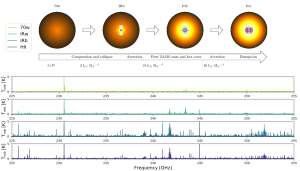
Fig. B: Simplified representation of the different phases of the evolutionary sequence of massive star-forming regions with their associated spectra;
Galactic structure
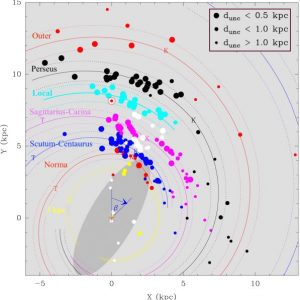
Fig. C: The Milky Way’s spiral structure as it would be seen from above the galactic plane, reconstructed from VLBI astrometry on masers associated with young massive stars (coloured dots);
Most of the molecular gas in our Galaxy is accumulated in the spiral arms, the locations where the most massive stars form. Precise astrometry of the masers associated with these objects can therefore trace the spiral arm structure and create a 3D model of the Galaxy. Very Long Baseline Interferometry provides the positional accuracy necessary to allow distance measurements through trigonometric parallaxes even beyond the Galactic Centre. It-ARC and IRA participate in a large project, called the Bar and Spiral Structure Legacy (BeSSeL) survey, which aims to measure accurate parallaxes and proper motions for more than 200 young massive stars, updating our view of the Galaxy. Furthermore, It-ARC/IRA researchers combine maser parallaxes with Gaia astrometry of stars to study spiral arms and the structure of molecular clouds.
Stellar masers
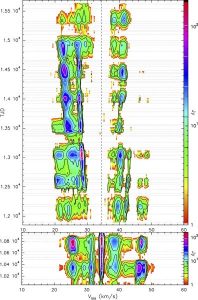
Fig. D: An example of long-term monitoring with the Medicina antenna of water masers in a circumstellar envelope. The diagram shows the evolution in time (days) of the flux density (colour scale) versus line-of-sight velocity (V_los) for the water masers associated with the Mira-like variable star IK Tau during the period 1995-2011;
Maser emission from the 616 − 523 rotational transition of water at 22 GHz is a common feature in circumstellar envelopes (CSEs), and is highly variable. A water maser monitoring has been conducted with the Medicina dish for decades. In CSEs the H2O masers originate close to the star, in the material expelled by it. The high variability reflects turbulent motions and indicates that the mass loss from the star is not a smooth process. Water masers are therefore well-suited to study changes in the stellar winds, that occur on timescales spanning from years to decades. Each single-dish H2O maser observation shows a snapshot of the maser activity, but it is not necessarily representative of the general behaviour. However, long-term monitoring can reveal (persistent) profile changes, episodic emission fluctuations, and strong bursts or flares in intensity lasting several (tens of) months. Open questions about stellar masers concern, for example, their lifetime, and how they can be used to study the history of stellar mass loss.
Credits
Nearby galaxies
The interstellar medium (ISM) is the multi-phase environment from which stars are formed, therefore it is extremely important for the formation and evolution of galaxies. Its multi-phase nature calls for multi-wavelength observations to trace its different components, from the most abundant, hydrogen in different phases (from hot ionized to cold molecular gas), to dust, cosmic rays and magnetic fields.
Nearby galaxies offer the opportunity to study the role of the ISM, and its different components, on star formation on large scales, while still being close enough to reveal the local details, thanks to the unprecedented combination of sensitivity and resolution offered by the current observational facilities. We are involved in studies of star formation processes through different tracers, exploiting the most powerful radio facilities currently available, such as ALMA, VLA, and LOFAR.
Magnetic fields play an important role in the ISM of spiral galaxies: they contribute to the total pressure, influence star formation processes at every scale, and may also affect the formation of spiral arms and outflows. They have typically been observed through synchrotron emission in total intensity and polarization. This emission is generally associated with massive star-formation processes: massive stars end their lives in supernovae explosions accelerating ultra-relativistic electrons, which spiral in the magnetic field. A new perspective on the study of magnetic fields in nearby galaxies is now made available by the unprecedented combination of high resolution and sensitivity in full polarization mode offered by ALMA, which enables to map the structure of interstellar magnetic fields in the cold gas of nearby galaxies, through observations of dust continuum polarization at the scale of giant molecular clouds. This is crucial to understand how magnetic fields influence gas dynamics and in particular their role in regulating star formation, driving galactic outflows and fueling galactic nuclei.
Gravitational interactions between galaxies lead to asymmetric gas flows, compression, shear, enhanced turbulence and outflows, which can modify the structure of galaxies and their star formation processes. A multi-wavelength study of nearby compact groups, relating the observed morphological and kinematic disturbances of group members, their star formation activity and history with the evolutionary history of the groups, is essential. Radio observations at low frequencies, allow to study the low-energy relativistic electron population, tracing the non-thermal radio emitting structures further away from the areas of relativistic particle supply, like in the halos or in tidal tails. The involvement of IRA researchers in LOFAR gives access to new low-frequency data on nearby compact groups. Galaxies in denser environments are affected by ram pressure stripping (RPS) of disk gas, due to interaction between the galaxy ISM and the intergalactic medium. Neutral gas studies have proved the efficiency of RPS in clusters of galaxies, but also tracers of other gas phases (e.g., Hα emission, X-ray) and even of young stars (UV, blue light) are used as complementary methods. At IRA, much interest is given to the presence of molecular gas in RPS tails, recently observed thanks to the high sensitivity provided by ALMA, but also to the possible radio continuum emission in the tails.
Contacts: R. Paladino (rosita.paladino@inaf.it)
Statistical properties of galaxies
Our expertise includes studies on the statistical properties of galaxies, especially number counts, luminosity functions, redshift and luminosity distributions. Our statistical analyses have been mainly used to work out galaxy evolution models (see “Galaxy evolution” page), to study correlations between physical properties of populations of galaxies (Bonato et al. 2017b) and to optimize the survey strategies for different telescopes (Bonato et al. 2014a,b, 2015, 2017a, 2019a). Our statistical studies have been focused on IR and radio surveys. Most of our analysed surveys have been performed by ALMA (Bonato et al. 2018, 2019b), WSRT (Bonato et al. 2021a), LOFAR (Bonato et al. 2021b), ATCA (Massardi et al. 2008, 2011a, 2013), WMAP (Massardi et al. 2009) and Planck (Massardi et al. 2011b).
Contacts: M. Massardi (massardi@ira.inaf.it), M. Bonato (bonato@ira.inaf.it)
References:
AGN jets
Our expertise includes analysis at a high angular resolution of relativistic jets in extragalactic sources through interferometric observations. The main goal is to discuss the composition, origin and evolution of the jets in different classes of objects, from BL Lacs, to nearby FRIs (isolated, in clusters, compact and extended, low power AGN), HzRGs and also QSOs. We are interested in the:
This is done thanks to VLBI observations in the radio bands and also with ALMA at higher frequencies, especially through archival data both in continuum and in polarization which is crucial to obtain strict constraints on the magnetic field and its evolution on the first part of the jets. We are members of EHT Collaboration and then interested in the study of these objects at very high angular resolution obtained with the Global mm-VLBI Array.
We are involved in the ALMACAL project (P.I. M. Zwaan, ESO), which aims to obtain calibrated images of all the ALMA calibrators (mainly blazars) for the first time. In this collaboration, our work is focused on the statistical study of the morphology and the correlation between the millimiter and gamma-ray emission of the blazar objects.
Our final goal is a multiband approach, investigating data from radio to X-ray, and exploiting also the new generation telescopes, such as SKA and E-ELT.
Contacts: E. Liuzzo (liuzzo@ira.inaf.it), M. Bonato (bonato@ira.inaf.it), N. Marchili (n.marchili@ira.inaf.it)
Galaxy evolution
Our expertise includes studies on photometric and IR/sub-mm spectroscopic properties of star-forming galaxies and of AGN (Massardi et al. 2016, 2018, Bonato et al. 2014a,b, 2015, 2017a), and on the galaxy and AGN (co-)evolution models (Massardi et al. 2010b, Bonato et al. 2014a,b, 2017b, 2019a). We have developed theoretical galaxy evolution models both in the IR (Bonato et al. 2014a,b, 2019a) and in the radio regime (Massardi et al. 2010, Bonato et al. 2017b). In the cited papers, we have used our models to work out predictions for observations with different facilities, such as the SPace IR telescope for Cosmology and Astrophysics (SPICA), the Origins Space Telescope (OST) and the James Webb Space Telescope (JWST). Our expertise is not limited to individual or populations of galaxies, but it also includes analysis of properties and modelling of galaxy clusters (Massardi & De Zotti 2004, Massardi et al. 2010a).
Contacts: M. Massardi (massardi@ira.inaf.it), M. Bonato (bonato@ira.inaf.it)